
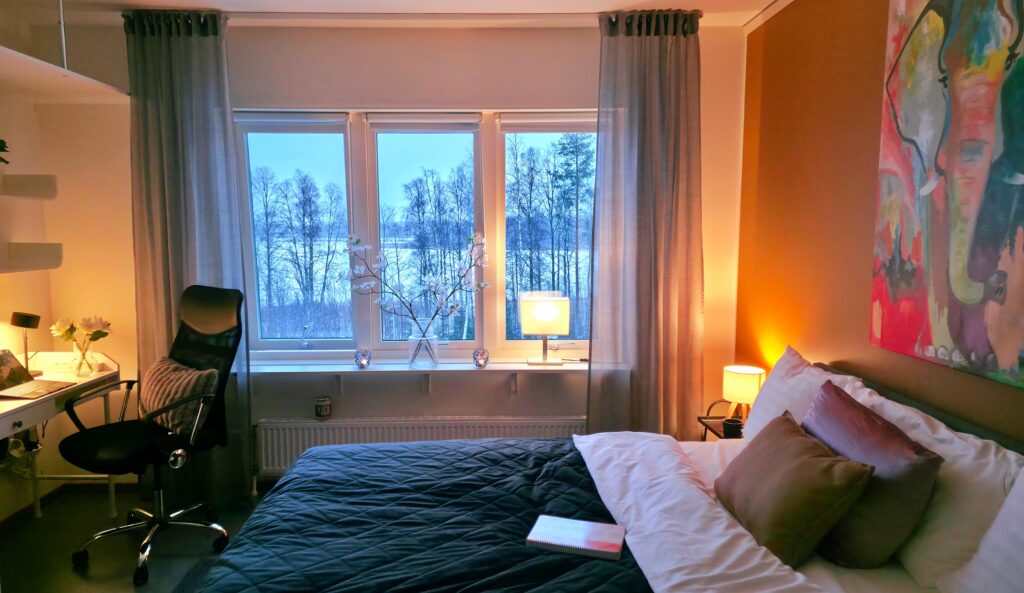
A few winters ago I went through a stretch where I genuinely dreaded going to bed. Not because of anything dramatic — my bedroom just felt cold and uninspiring, a place I slept rather than a place I wanted to be. A friend who had just returned from a trip to Copenhagen kept talking about the apartment she had stayed in there, and the way it had made her feel calmer just by existing in it. She used the word hygge so many times that weekend that I finally looked it up properly.
That conversation sent me down a months-long rabbit hole into Scandinavian design, and eventually into completely redoing my own bedroom around its principles. What I discovered surprised me. I had always assumed Scandinavian style meant cold, sparse, IKEA-showroom minimalism. It is almost the opposite. Done properly, a Scandinavian bedroom is one of the warmest, coziest, most genuinely restful spaces you can create — it just achieves that warmth through restraint rather than abundance.
Here is everything I learned transforming my own bedroom into a Scandinavian retreat, room by room, decision by decision.
1. Understand What Scandinavian Bedroom Ideas Are Really About
Before I changed a single thing in my bedroom, I spent a few weeks just reading and looking at images, trying to understand what actually made a Scandinavian space feel the way it did. The answer, I eventually realized, has very little to do with specific objects and everything to do with light, warmth, and restraint working together.
Scandinavian countries deal with extraordinarily long, dark winters. Their design philosophy developed directly in response to that reality — every design decision is in service of maximizing the natural light that does exist and creating physical warmth and comfort to compensate for the months when it does not. That is why Scandinavian interiors are full of white walls, why candles are everywhere, why textures are so generously layered. It is not decoration for decoration’s sake. It is design solving a genuine problem.
What this meant for my own approach: I stopped thinking about Scandinavian style as a list of objects to buy and started thinking about it as two questions for every decision — does this maximize light, and does this add warmth? Surprisingly, that reframing made every subsequent choice in my bedroom much easier.
Pro Tip: Before buying anything for a Scandinavian bedroom, ask whether it makes the room feel brighter or warmer. If it does neither, it probably does not belong. For more on the philosophy behind this style check our guide on scandinavian small space decor.
2. Paint Your Walls a Genuinely Warm White
This was the very first change I made, and it remains the one I think about most when people ask where to start.
I had a slightly cool white on my walls before — the kind that looks fine on a paint chip but feels faintly clinical once it is covering four walls and a ceiling. I repainted with a warm white that has the faintest hint of cream in it, and the difference was far more dramatic than I expected from something as simple as swapping one white for another.
Why the warm undertone matters so much: Cool whites reflect light in a way that can feel sterile, almost hospital-like, especially in artificial light in the evenings. Warm whites do the same job of bouncing light around a small room, but they do it with a softness that feels inviting rather than clinical. Once I made the switch, everything else in my room — my wood furniture, my plants, my bedding — suddenly looked warmer too, simply because of what was reflecting onto them.
What I chose specifically: A shade with a barely perceptible cream undertone, painted on both the walls and the ceiling. I was nervous about painting the ceiling the same color as the walls, worried it might feel flat, but it actually made my fairly average-height room feel taller, because there is no harsh line where wall meets ceiling to stop the eye.
Pro Tip: Buy a small sample pot and paint a section of wall before committing to a full room. Look at it in the morning, midday, and evening light, because warm whites can shift subtly depending on the light hitting them. For more on getting your palette right check our guide on color schemes for small rooms.
3. Choose a Low, Simple Bed Frame in Warm Wood
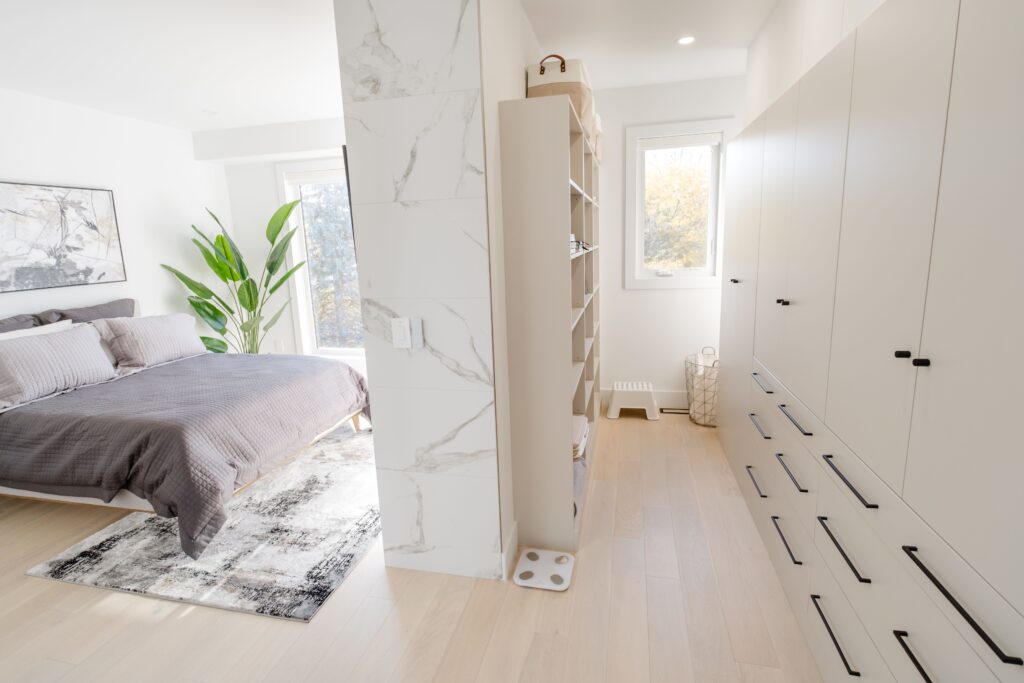
My old bed frame was a dark, slightly ornate metal frame I had inherited from a previous flatmate. It worked fine functionally, but it never quite fit the room, and I could never put my finger on why until I started researching Scandinavian style and realized how central simple wood furniture is to the whole aesthetic.
What I replaced it with: A low platform bed frame in pale oak, with completely plain, unfussy lines. No headboard beyond the wall itself, no carved details, nothing decorative about the frame at all. The bed exists to hold the mattress beautifully and otherwise gets out of the way visually.
Why low and simple works so well: A low bed frame makes the ceiling feel higher by comparison, which matters enormously in a smaller bedroom. And the simplicity of the frame means it never competes visually with the textiles and accessories layered onto it — which in Scandinavian style is where all the warmth and personality actually lives.
Pro Tip: If a full bed frame replacement is not in your budget right now, removing an elaborate headboard or simply lowering your existing setup with a platform base can achieve a surprising amount of the same effect. For bedroom furniture ideas check our guide on how to decorate a small bedroom.
4. Layer Cozy Textiles Generously
This is the part of Scandinavian bedroom ideas that genuinely surprised me, because it runs counter to the assumption that this style means having less. In terms of textiles specifically, it actually means having more — just chosen and layered with real intention.
What I layered onto my bed and chair: A chunky cream knit throw folded at the foot of my bed. A faux sheepskin draped over the armchair in the corner, which I touch almost every time I walk past it because the texture is so satisfying. A waffle-weave cotton blanket as a lighter layer for warmer months. Linen pillowcases that have gotten progressively softer with every wash.
The principle behind the layering: Each textile brings a different texture — chunky knit, soft sheepskin, crisp linen, waffle cotton — so that even though the color palette stays narrow and calm, the room never feels flat or one-dimensional. Your hands and body experience the room as richly as your eyes do.
My honest experience: The sheepskin on my armchair was the purchase I was most skeptical about and has turned out to be the one I would replace first if anything happened to it. There is something about sitting down into real texture at the end of a long day that a smooth, uniform surface simply cannot replicate.
Pro Tip: Buy textiles in slightly different but related warm neutral tones rather than one single matching shade — the subtle variation reads as more intentional and more interesting than perfect uniformity. For textile layering ideas check our guide on cozy room ideas.
5. Replace Bedside Tables With Floating Shelves
I genuinely did not expect this change to matter as much as it did. I assumed swapping my slightly clunky bedside tables for simple floating shelves was purely a space-saving move, and I was completely unprepared for how much it would also affect the feel of the room.
What I installed: Two simple oak floating shelves, one on each side of the bed, mounted at the same height as my old tables would have been.
What actually changed: With the floor space beneath them now completely visible and clear, the whole sleeping area felt noticeably more open. There was less visual clutter at floor level pulling my eye downward, and the room read as calmer the moment I walked in, even though functionally the shelves do exactly what the tables did.
What lives on them now: One small ceramic lamp on each side, one current book, and almost nothing else. I have had to be more disciplined about what earns a place there, because there is no drawer to hide things in, and that discipline has turned out to be exactly the point.
Pro Tip: Install floating bedside shelves slightly lower than a standard table height — somewhere around chest height when seated in bed — it creates a more grounded, intentional feel than positioning them at standard furniture height. For floating shelf ideas check our guide on vertical storage ideas for small spaces.
6. Light Candles as a Daily Ritual, Not an Occasion
Before this whole project, candles were something I lit maybe four or five times a year, always for some specific occasion. One of the genuinely life-changing parts of adopting Scandinavian bedroom ideas was realizing that candles are meant to be a daily habit, not a special treat.
My current setup: Three simple cream pillar candles of slightly different heights, grouped on a small wooden tray on my windowsill. I light them most evenings, usually around the time I would otherwise switch on a bright overhead light.
Why this became such a meaningful shift: There is something about the act of lighting a candle that marks a transition — it signals to my own brain that the working part of the day is over and the resting part has begun, in a way that simply dimming a light switch never quite manages. The light itself is also genuinely more flattering and calming than almost any bulb I have tried.
The cost reality: I buy plain, unscented pillar candles from a homeware shop, and a pack lasts me a couple of months even with near-daily use. This is not an expensive habit, despite how luxurious it feels.
Pro Tip: Group candles of varying heights together on one small tray rather than spreading single candles around the room — the cluster creates a more concentrated, atmospheric pool of light. For candle and lighting ideas check our guide on small space lighting ideas.
7. Choose One Architectural Plant Rather Than Many Small Ones
I went through a phase before this project of collecting small plants somewhat randomly, and my windowsill ended up looking cluttered rather than alive. Scandinavian style taught me to be far more selective.
What I have now: A single, fairly tall snake plant in a plain white ceramic pot, positioned in the corner of the room where it gets indirect light through the curtain.
Why one plant works better here: In a room built around restraint, one carefully chosen plant with a strong, clean silhouette reads as a deliberate design choice. A windowsill crowded with five or six different small plants, however much I loved each one individually, read as slightly chaotic and pulled attention away from the calm I was trying to build.
Pro Tip: Choose a plant with an architectural, upright shape rather than a sprawling one for a Scandinavian bedroom — snake plants and similar varieties read as far more intentional than bushier options. For plant ideas check our guide on small space plants ideas.
8. Keep Surfaces Genuinely Clear
This sounds obvious written down, but it took me longer than I would like to admit to actually internalize it. I kept adding small decorative objects to surfaces because each individual thing felt harmless, and then wondering why the room never quite achieved the calm I was hoping for.
What changed my approach: I started applying a simple rule — every surface in my bedroom gets a maximum of three objects, with visible space between them. My dresser top has my lamp, one small dish for jewelry, and nothing else. My floating shelves each hold a lamp, a book, and occasionally a small candle.
What this felt like at first: Genuinely uncomfortable. I am someone who likes having things around me, and the empty space initially felt like something was missing. After about two weeks I stopped noticing the absence and started noticing how much more I appreciated the few objects that remained.
Pro Tip: If a surface feels incomplete after editing it down, resist the urge to add another decorative object and add a small plant instead — living things fill space in a way that feels alive rather than cluttered. For decluttering approaches check our guide on small space living tips.
9. Use Soft, Warm Lighting Instead of Bright Overheads
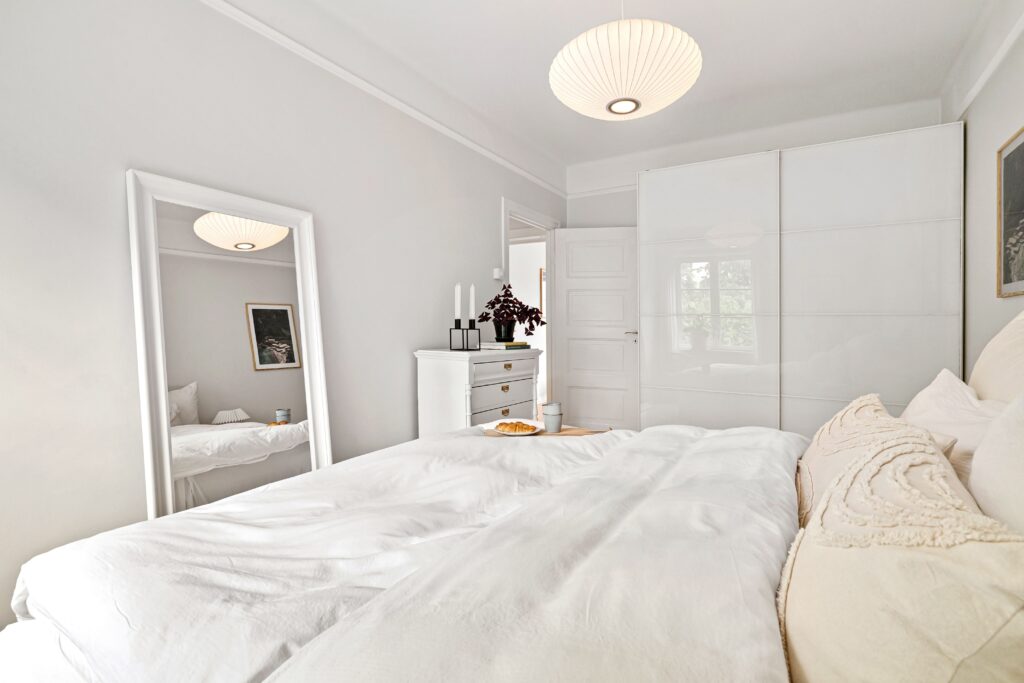
My bedroom originally had a single central ceiling light with a fairly bright, cool bulb, and it was the very last thing I addressed in this whole process, mostly because I did not realize how much it was undermining everything else I had done.
What I changed: I now use my bedside lamps as the primary evening light source and rarely turn the overhead light on after early evening. Both lamps have warm 2700K bulbs, and the overhead bulb itself got swapped to a warmer tone too, for the rare occasions I do need brighter light to find something.
The effect of this single change: Everything I had already done — the warm walls, the wood furniture, the textiles — suddenly looked the way I had originally pictured it. Cool, bright overhead light had been flattening all of that warmth without my realizing it.
Pro Tip: Swap your bulbs before you swap anything else in a bedroom you are trying to make feel more Scandinavian — it is the cheapest change on this entire list and arguably the one with the most immediate visual impact. For more lighting guidance check our guide on small space lighting ideas.
10. Maintain the Calm With a Short Daily Reset
None of this stays beautiful on its own. I learned that fairly quickly when my newly calm bedroom slid back into mild chaos within about three weeks of finishing the project, simply through normal daily life.
What I do now: A genuinely short routine, no more than five minutes, every evening before bed. The throw gets refolded at the foot of the bed. Clothes go where they belong rather than over the chair. The shelves get a quick scan to make sure nothing has crept onto them that should not be there.
Why this small habit matters so much: A Scandinavian bedroom depends on visible restraint to work its calming effect, and restraint erodes quickly if nothing actively maintains it. Five minutes a day has turned out to be a small enough commitment that I genuinely keep it up, where a more elaborate weekly deep clean kept getting skipped.
Pro Tip: Attach your reset routine to something you already do every night, like brushing your teeth, so it becomes automatic rather than something you have to remember separately. For more on building sustainable habits in a small space check our guide on small space decor mistakes.
My Final Thoughts
That conversation about a Copenhagen apartment a few winters ago genuinely changed how I think about my bedroom, and by extension how I feel most evenings when I walk into it. I no longer dread going to bed. If anything, my bedroom has become the room in my apartment I most look forward to spending time in, candle lit and quiet, after a long day.
The warm white walls, the low simple bed frame, the generously layered textiles, and the nightly candle ritual made the biggest difference for me personally, but every single change on this list played its part in getting there.
If you only do one thing this week, swap your bedside bulbs for warm ones and light a candle tonight. It sounds too small to matter. It is not.
Which of these scandinavian bedroom ideas would make the biggest difference in your own room? Tell me in the comments, I would genuinely love to know.
For more small space inspiration explore all our articles on Tiny Room Style!