
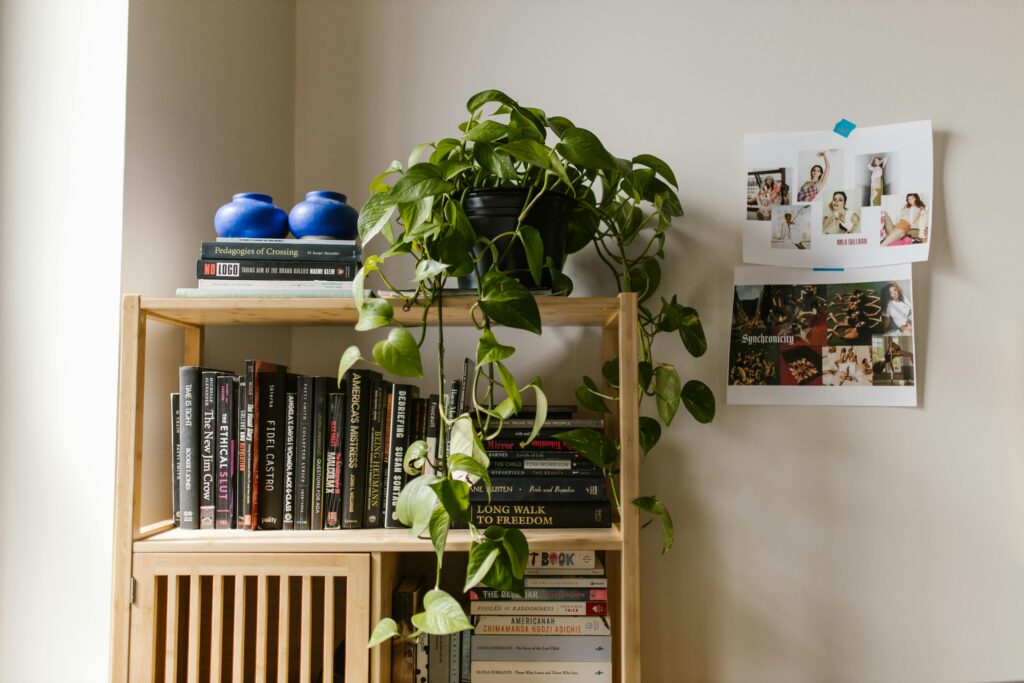
I have styled and restyled my bookshelves more times than I can count. I have read every guide, watched every tutorial, and tried every technique. And I have made every mistake — the overcrowded shelf that looks chaotic, the underpopulated shelf that looks bare, the symmetrical arrangement that looks sterile, the random arrangement that looks accidental.
What I am sharing here is what I have learned from years of trial and error — the principles and techniques that have consistently created beautiful bookshelf displays in my small apartments, in various aesthetic styles, with various collections of books and objects.
This is the guide I wish I had found at the beginning!
1. The Foundation Principle — Edit Before You Style
Every bookshelf styling attempt I have made that failed started with the same mistake — I tried to style everything I owned rather than styling a curated selection of what I owned.
Beautiful bookshelf displays in small spaces are not about showing everything. They are about showing the right things — the books you genuinely love, the objects that are genuinely beautiful, the plants that are genuinely healthy, arranged with genuine intention.
My pre-styling edit process:
I remove absolutely everything from the shelf. I sort through it all on the floor. I ask three questions about each item — Is it genuinely beautiful? Does it mean something to me? Is it in good condition?
Items that receive a yes to all three questions go into the “definitely keep” pile. Items that receive a yes to one or two questions go into the “consider” pile. Items that receive a no to all three go directly to donation or disposal.
I then style using only items from the “definitely keep” pile. If the shelf looks bare, I selectively add items from the “consider” pile. If it still looks bare — I add plants, not more objects.
The result every time: A shelf that looks significantly more beautiful with significantly fewer items than I started with.
Pro Tip: The most common bookshelf styling mistake in small spaces is overcrowding — filling every available centimeter with objects. Beautiful shelf displays have breathing room. Items displayed with space around them look significantly more valuable and more intentional than the same items crammed together. For decluttering ideas check our guide on small space living tips.
2. Organize Books by Color — The Single Biggest Visual Transformation
This is the one bookshelf styling technique that I recommend above all others — because the visual transformation it creates is immediate, dramatic, and requires no new purchases whatsoever.
The before: My bookshelf before color organization was a random arrangement of books in various sizes and colors. It looked like what it was — a collection of books accumulated over years with no visual organizing principle.
The after: After organizing by color — cream and white spines first, then warm beige and tan, then warm orange and terracotta, then rich brown and dark warm tones — my bookshelf looked like a designed, intentional display. The same books. The same shelf. An entirely different visual impact.
My color organization system:
- I group books by color family rather than exact color — all warm light tones together, all warm mid-tones together, all warm dark tones together
- Within each color group I arrange by height — tallest at the outer edges of each group, shortest in the middle — creating a slight arc within each color section
- I leave gaps between color groups — the breathing space between groups creates definition and prevents the arrangement from looking like a single undifferentiated block of books
What to do with books that do not fit your color palette: Turn them spine-inward, displaying the page edges instead. A section of books displayed page-outward creates a beautiful warm white or cream block in your color arrangement — and is a genuinely elegant solution for books with visually jarring covers.
Pro Tip: Warm-toned book collections photograph and display more beautifully than cool-toned ones — cream, tan, brown, and warm orange spines create a naturally cohesive palette. If your book collection has many cool-toned spines, turning them page-outward and displaying only warm-toned spines face-outward creates a more immediately beautiful color-organized display. For color ideas check our guide on color schemes for small rooms.

3. Use the Rule of Three for Object Groupings
The rule of three is the bookshelf styling principle that transformed my object arrangements from looking random to looking curated — and it is simple enough to implement immediately.
The rule: Group objects in odd numbers. Three is the most versatile. Five works for larger groupings. Even numbers — two, four, six — create symmetry that can feel sterile. Odd numbers create visual movement and interest.
How I apply the rule of three on my shelves:
Each grouping on my shelf contains three elements. These three elements always vary in three dimensions:
- Height — one tall, one medium, one short
- Texture — one smooth, one rough or organic, one somewhere between
- Color — two elements in my neutral palette, one element in my accent color
A typical grouping on my shelf might be: a tall ceramic vase (smooth, neutral), a small rattan basket (rough, neutral), and a small terracotta plant pot with a succulent (earthy, accent color).
The breathing space rule: Between each grouping of three, I leave deliberate empty space — approximately the width of one book. This space is not a gap to be filled. It is a design element that creates definition between groupings and allows each group to breathe and be seen distinctly.
Pro Tip: If a grouping of three feels incomplete, add a plant rather than a fourth object — a small trailing plant or a succulent added to an existing grouping of two objects creates a beautiful three-element grouping with organic life that no manufactured object can replicate. For shelf styling ideas check our guide on small space plants ideas.
4. Vary Heights Throughout
Varying heights throughout a bookshelf display is the technique that creates visual movement — the quality that makes a shelf display feel dynamic and interesting rather than flat and static.
The mistake I used to make: I arranged everything on my shelves at approximately the same height — books all upright, objects all at similar heights, plants all small. The result was a shelf that looked organized but not beautiful — there was no visual journey for the eye to take.
The technique that changed everything: I deliberately varied heights across and within each shelf level.
How I vary heights:
Between shelves: My tallest items — a large trailing plant, my tallest books, my largest objects — live on the highest shelves. My shortest items — small succulents, small objects, horizontally stacked books — live on the lower shelves. This creates a visual gradient from large and dramatic at top to small and detailed at bottom.
Within each shelf: I mix vertical and horizontal books. I stack two or three books horizontally and place a small object or plant on top — creating a mini-platform at a different height from the upright books around it. I group objects of varying heights together.
The horizontal stack technique: This is my most-used height variation tool. Stacking three books horizontally and placing a small ceramic object or plant on top creates a perfect height variation platform that also displays the stacked books beautifully — showing their covers rather than their spines.
Pro Tip: Your tallest, most dramatic item — whether a tall plant, a sculptural object, or a stack of large art books — should anchor one end of your shelf display. It creates a visual starting point from which the eye travels across the shelf. Without a height anchor, shelf displays feel without beginning or end. For height variation ideas check our guide on aesthetic room decor ideas.
5. Add Plants to Every Shelf Level
Adding plants was the single change that most improved my bookshelf styling — and the one I now consider non-negotiable for beautiful bookshelf displays.
Why plants transform bookshelf displays: They add life. Genuine, organic, living life that no manufactured object can replicate. A shelf display without plants looks beautiful. The same display with plants looks alive — and alive is always more beautiful.
My plant approach for each shelf level:
Top shelves: Trailing plants — a golden pothos, a string of pearls, a trailing string of hearts. These trail downward from the top shelves, adding organic movement and cascading beauty that draws the eye from top to bottom of the shelf.
Middle shelves: Small upright plants — a compact snake plant, a small fern, a ZZ plant. These add height variation and organic texture at the most visible shelf level.
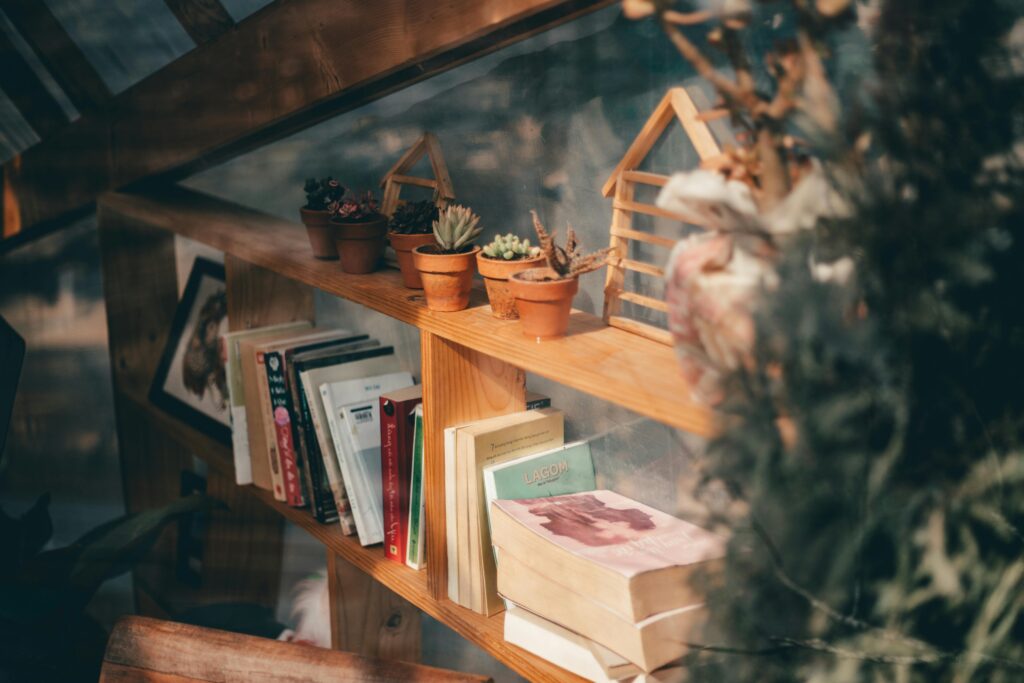
Bottom shelves: Small succulents and cacti in beautiful pots — terracotta, white ceramic, or rattan. These add living texture at the lowest level without occupying significant space.
The plant pot selection: I use a consistent pot style throughout my shelves — all terracotta, or all white ceramic, or all rattan. The consistent pot style creates visual cohesion across the plant elements throughout the shelf display.
Pro Tip: A trailing golden pothos on your highest shelf is the single most impactful plant addition to any bookshelf display. Its trailing quality adds organic movement, its golden-green color complements almost every aesthetic, and it grows enthusiastically with minimal care — the trailing length increasing over time, making the shelf display more beautiful as the plant matures. For plant shelf ideas check our guide on small space plants ideas.
6. Add One Statement Object Per Shelf
In addition to grouped collections of smaller objects, I include one statement object on each shelf level — a single, significant item that anchors the shelf and creates a focal point.
My current statement objects:
- Top shelf: A large rattan lantern — tall, warm, and architecturally beautiful
- Second shelf: A beautiful handmade ceramic bowl — imperfect, organic, and deeply personal
- Third shelf: A vintage brass clock — characterful, warm, and genuinely aged
- Bottom shelf: A large piece of driftwood — naturally shaped, coastal, and unique
Each statement object is significantly larger than the surrounding grouped objects. This size contrast creates visual hierarchy — the eye finds the statement object first, then explores the surrounding groupings.
How I choose statement objects: They must be genuinely beautiful to me — not just conventionally attractive. They must be in good condition — a statement object with chips or damage draws attention to its flaws. And they must be in keeping with the overall aesthetic of the shelf display.
Pro Tip: Handmade and found objects make the most beautiful statement objects for bookshelf displays — a handmade ceramic, a piece of driftwood, a beautifully weathered vintage object — because their natural imperfections and genuine history add warmth that manufactured objects cannot replicate. For statement object ideas check our guide on how to make a small apartment feel like home.
7. Use Consistent Finishes and Tones
The most immediately visible quality of a beautifully styled bookshelf — and the most immediately visible quality of a poorly styled one — is color coherence.
Beautiful shelves have a consistent color story. Poorly styled shelves have competing colors that fight each other for attention.
My color story for my current bookshelves: Warm white and cream from the book pages and light-toned spines. Warm terracotta from my plant pots. Warm oak from the shelf surface itself. Warm natural from my rattan and organic objects. Warm brass from my one vintage clock and a small brass object. Warm green from my plants.
Everything within the warm family. Nothing cool, nothing jarring, nothing that competes with the overall warmth.
How I maintain color coherence: When I add a new object to my shelves, I hold it against the existing display and ask — does this feel like it belongs? Does it share the color family? Does it feel warm or cool? If it feels wrong or cool, it does not go on the shelf regardless of how much I like it in isolation.
Pro Tip: Natural materials — wood, ceramic, rattan, stone, linen — have inherently warm tones that naturally complement each other. Building your shelf display primarily from natural materials creates color coherence almost automatically — because natural materials share the warm, organic color family that makes shelf displays beautiful. For color coherence ideas check our guide on color schemes for small rooms.
8. Include Personal and Meaningful Objects
The most beautiful bookshelf displays I have ever seen — in homes I have visited, in photographs I have saved — are the ones that feel genuinely personal. Not styled to look impressive. Styled to feel like the person who lives there.
Personal objects on my current shelves:
- A small ceramic dish I made in a pottery class — visibly imperfect and deeply meaningful
- A postcard from my favorite city, framed in a small simple frame
- A crystal given to me by my closest friend, placed in a small terracotta dish
- A photograph from my most meaningful trip, printed small and propped against a book
None of these objects is conventionally impressive. All of them add a warmth and personal quality to my shelf display that no purchased decorative object could replicate.
The insight: Visitors to my apartment consistently spend the most time looking at and asking about the personal objects on my shelves — the handmade ceramic, the meaningful photograph, the crystal from a friend. These objects create connection and conversation in a way that beautiful but impersonal objects never do.
Pro Tip: Include at least two genuinely personal objects on every shelf — objects that are specifically yours, that could not be on anyone else’s shelf, that tell your story in a way that no purchased decorative object can. These personal elements are what transform a beautifully styled shelf into a shelf that feels like yours. For personal styling ideas check our guide on cute room decor ideas.
9. Light Your Shelves
Lighting is the bookshelf styling element that most people never consider — and that makes one of the most dramatic differences to how shelves look, particularly in the evenings.
How I light my shelves:
Fairy lights: A string of copper wire fairy lights woven through my books and objects along the back of my middle shelf. In the evenings, this single string of lights transforms my shelf from a daytime display into something genuinely magical — the warm points of light between and behind the books and objects create depth and atmosphere.
Candles: Small candles — tea lights in ceramic holders, small pillar candles — placed among the objects on one or two shelf levels. When lit in the evenings, the warm candlelight creates the most beautiful, intimate shelf atmosphere possible.
A small lamp: On my lowest shelf I have a very small ceramic lamp — it provides warm, localized light to the lower shelf level and adds a warm glow to that area of the display throughout the evening.
The evening transformation: My bookshelves look beautiful in daylight — natural light shows the colors and textures clearly. But in the evening, with fairy lights, candles, and the small lamp, they look extraordinary — warm, atmospheric, and genuinely magical.
Pro Tip: Add fairy lights to your bookshelves this evening — before implementing any other styling change. Weave them through your existing arrangement however it currently looks. The warm twinkle of lights on a bookshelf creates immediate beauty that no amount of rearranging objects achieves as quickly or as affordably. For lighting ideas check our guide on small space lighting ideas.
10. Edit Regularly and Evolve Slowly
The final bookshelf styling principle — and the one that keeps all the others working over time — is regular editing and slow evolution.
My bookshelf editing practice: Every month I spend approximately thirty minutes looking at my shelves with genuinely fresh eyes. I ask — what is working? What feels slightly wrong? What have I stopped noticing? What has accumulated without being deliberately chosen?
Items I have stopped noticing are removed. Items that feel slightly wrong are repositioned or replaced. New items that I genuinely love are added in the spaces created by removals.
The slow evolution principle: Beautiful shelf displays evolve slowly and deliberately — not through dramatic overnight changes but through gradual, considered additions and subtractions over time. My current shelf display has evolved over approximately fourteen months. It started as a rough version of its current self and has become progressively more refined with each monthly editing session.
What regular editing prevents: The gradual accumulation of objects that no longer serve the display. The slow creep of clutter into spaces that should breathe. The drift toward overcrowding that happens naturally when new objects are added without old ones being removed.
My editing rule: Nothing new comes onto the shelf without something leaving. If I find a beautiful ceramic that I want to add, something currently on the shelf must be removed to make space for it. This constraint keeps the shelf at its ideal density — full enough to feel warm and personal, spacious enough to feel curated and beautiful.
Pro Tip: Photograph your shelves monthly — the same angle, the same lighting, as consistently as possible. Looking at a series of monthly photographs reveals the evolution of your display over time and shows you clearly what has worked, what has not, and how your aesthetic has developed. This photographic record is also genuinely enjoyable to look back on after a year. For ongoing shelf styling ideas check our guide on aesthetic room decor ideas.
My Final Thoughts
Styling bookshelves in small spaces has been one of the most consistently rewarding decorating practices in my life — because bookshelves are the most personal surface in any home, and styling them well creates a display that is both beautiful and deeply, specifically yours.
The color organization, rule of three, height variation, plants on every level, and regular monthly editing have had the biggest cumulative impact. But every principle on this list has contributed to creating shelf displays that I genuinely love looking at every day.
Start tonight — take everything off one shelf and reorganize your books by color. Just one shelf. The transformation will be immediate and it will inspire you to continue throughout your display.
Which of these bookshelf styling ideas are you going to try first? Tell me in the comments — I would love to see photographs of your transformed shelves!
For more small space inspiration explore all our articles on Tiny Room Style!
Pingback: IKEA Small Space Hacks: 10 Genius Ways to Maximize Your Tiny Home - Tiny Room